


Policy Summary and Key Contacts
This policy sets out ITC’s commitment to protecting children and young people from abuse, neglect and harm. It applies to everyone acting for, studying with, visiting or providing services to ITC. It explains how to recognise concerns, respond to disclosures, escalate and report concerns, and keep appropriate records.
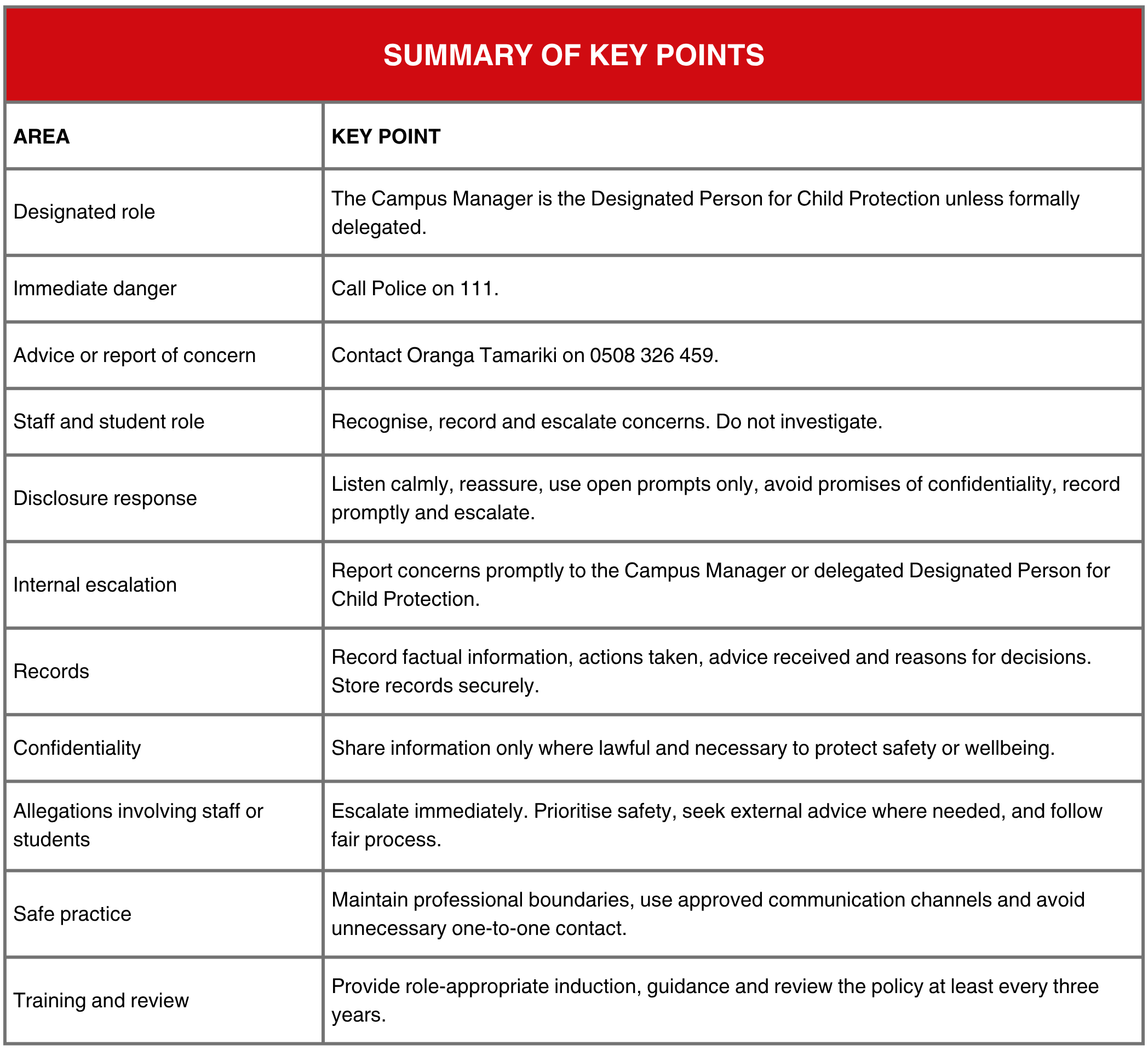
Key contacts: call Police on 111 if a child or young person is in immediate danger.
Contact Oranga Tamariki on 0508 326 459 for advice or to make a report of concern.
Internally, report concerns promptly to the relevant Campus Manager, who is the Designated Person for Child Protection unless this role has been formally delegated.
Application
This policy applies to all ITC staff, students, contractors, volunteers, visitors, external providers and others acting for ITC. It applies whenever they may have contact with children or young people through ITC activities, including on campus, online, school visits, campus tours, events, placements, field trips, external provider activities and ITC-related communication.
Scope in ITC Context
This policy protects all children and young people ITC may engage with, including students under 18, prospective students, school groups, children of students or visitors, and children encountered during ITC-approved activities. When ITC staff or students operate within another organisation, that organisation’s child protection policy must also be followed where relevant. If procedures conflict, the safest response for the child or young person takes priority while advice is sought.
Purpose and Principles
- The safety, wellbeing and rights of the child or young person are the primary consideration in all decisions.
- Concerns must be taken seriously, responded to promptly, and recorded accurately.
- Staff and students are not expected to investigate child protection concerns themselves, their responsibility is to recognise, record and escalate concerns.
- ITC supports early intervention and the least intrusive response necessary to protect the child or young person.
- Family, whānau and cultural context should be respected unless doing so would increase risk to the child or young person.
- Staff and students must be able to raise concerns or challenge unsafe practice without fear of reprisal.
- Information may be shared where lawful and necessary to protect a child or young person from harm.
This policy supports staff and students to identify, respond to, escalate, report and record child protection concerns.
Related Legislation, Regulations and ITC Documents
- The following documents set out further information relevant to this policy:
- Children’s Act 2014
- Education and Training Act 2020
- Family Violence Act 2018
- Harmful Digital Communications Act 2015
- Health and Safety at Work Act 2015
- Human Rights Act 1993
- Employment Relations Act 2000
- ITC Student Code of Conduct
- ITC Staff Code of Conduct
- Education (Pastoral Care of Tertiary and International Learners) Code of Practice 2021
- Health Information Privacy Code 2020
- Oranga Tamariki Act 1989
- Privacy Act 2020
Definitions
The following definitions apply to this document:
- Child means a person who is under the age of 18 years.
- Child abuse means harm (whether physical, emotional, or sexual), ill-treatment, abuse, neglect, or deprivation of a child.
- Child protection means actions taken to keep children and young people safe from abuse, neglect, harm or risk of harm.
- Disclosure means information suggesting abuse, neglect, harm or risk of harm, shared by a child, young person, parent, caregiver, student, staff member or third party.
- Designated Person for Child Protection means the Campus Manager or delegated person responsible for receiving concerns, supporting staff and students, coordinating escalation, external reporting, implementation and review.
- Neglect means persistent failure to meet a child or young person’s basic physical, emotional, medical, educational or supervision needs.
- Family violence means violence, abuse, coercive control or intimidation within family, whānau or close personal relationships. Exposure to family violence can be a child protection concern.
Recruitment, employment and enrolment (safety checking)
Where required by law or contract, ITC will complete safety checks for relevant roles in line with the Children’s Act 2014. Checks may include identity confirmation, police vetting, interviews, referee checks, work history checks, registration checks and risk assessment. Required checks must be completed before the person starts and updated at least every three years.
Identifying suspected child abuse
Staff and students are not expected to investigate concerns. Their role is to recognise possible signs, record relevant facts, and escalate concerns promptly.
Indicators of Abuse, Neglect and Family Violence
- Physical indicators may include unexplained injuries, bruising, burns, fractures, frequent injuries, untreated medical needs, or signs that do not match the explanation given.
- Behavioural indicators may include fearfulness, withdrawal, aggression, sudden behavioural change, disengagement, anxiety around particular people or places, sexualised behaviour, substance misuse, eating concerns or self-harm indicators.
- Emotional abuse or neglect indicators may include low self-worth, excessive compliance, isolation, social difficulty, threats, degradation, exploitation, rejection or exposure to harmful behaviour.
- Neglect indicators may include inadequate food, clothing, hygiene, supervision, medical care, emotional support, or persistent unmet educational needs.
- Family violence indicators may include descriptions of violence or fear at home, distress linked to family conflict, controlling behaviour, or being used to threaten or control another family member.
Responding to a Disclosure
- Listen calmly and allow the child or young person to speak in their own words.
- Reassure them that they have done the right thing by telling someone and that they are not in trouble.
- Use open prompts only, such as “What happened next?”, and do not interview, investigate, pressure or challenge them.
- Do not promise confidentiality. Explain that information may need to be shared to keep them safe.
- If there is immediate danger, call Police on 111.
- Record the disclosure promptly, including exact words, date, time, location, people present, observations and actions taken.
- Escalate immediately to the Campus Manager or delegated Designated Person for Child Protection.
Step-by-Step Reporting Process
- If the child or young person is in immediate danger, call Police on 111.
- If there is no immediate danger, listen, reassure, avoid questioning, and keep the child or young person safe.
- Record facts promptly, using the child or young person’s own words where relevant.
- Escalate the concern to the Campus Manager or delegated Designated Person for Child Protection.
- The Campus Manager decides whether to seek advice or make a report to Oranga Tamariki or Police.
- If reported externally, record who was contacted, when, advice received, actions taken and reasons.
- Store all records securely and limit access to those with a legitimate need to know.
- Arrange appropriate support while maintaining confidentiality and safety.
Reporting and Escalation
Reporting child protection concerns can be stressful. ITC encourages those involved to access appropriate support, including confidential counselling where available.
A person who makes a good-faith report under the Oranga Tamariki Act 1989 is protected from civil, criminal or disciplinary proceedings for making that report.
Allegations Involving Staff or Students
Any allegation involving ITC staff, students, contractors, volunteers, visitors or external providers must be reported immediately to the Campus Manager and escalated to the relevant senior manager. The child or young person’s safety comes first. ITC may separate the person who is the subject of the concern while advice is sought.
If the concern may involve abuse, neglect, harm or risk of harm, ITC will seek advice from Oranga Tamariki and/or Police before taking action that could affect an external investigation. Any employment, disciplinary or student conduct process must follow natural justice, relevant contracts, ITC procedures and applicable law. Historical allegations must be taken seriously. ITC will not use settlement or informal arrangements to conceal or minimise child protection concerns.
Safe Practice Expectations
- Avoid being alone with a child or young person where practicable, use open and observable settings.
- Maintain professional boundaries at all times, including in person, online and through messaging or social media.
- Use ITC-approved communication channels for ITC-related contact with children or young people.
- Do not transport a child or young person alone unless necessary in an emergency or approved by ITC.
- Supervise visitors, presenters and external providers when they engage with children or young people through ITC activities.
- Do not give personal gifts, form over-familiar relationships, or use private contact that may create safeguarding risks.
Training, Induction and Supervision
Relevant staff will receive child protection information during induction and role-appropriate guidance on recognising, responding to and reporting concerns. Campus Managers and delegated Designated Persons should receive additional guidance. Students engaging with children or young people through ITC activities, placements or external settings must be briefed before the activity begins.
Confidentiality
- All actions taken must be with appropriate care to maintain confidentiality.
- Information may be shared where there is a lawful basis, including to protect a child or young person’s safety or wellbeing. Shared information must be relevant, accurate and limited to what is necessary.
Review and Continuous Improvement
This policy will be reviewed at least every three years, or earlier after relevant legal, regulatory, contractual or organisational changes, or after a significant child protection concern. Reviews will consider feedback, accessibility, reporting processes, training, recordkeeping and current safeguarding guidance. The Quality Manager coordinates the review with Campus Managers and senior leadership.
Document management and control
Prepared by: Senior Management team
Owned by: Quality Manager
Approved by: CE
Date approved: 5th August 2026
Review date: July 2029, or earlier if legislation, regulatory guidance, contractual requirements, or organisational practice changes.